
Menopause at Work Series (2)  7 Min Read 2025
Part 2 - Menopause at Work: About Menopause
Stevenson Brown
You are reading Part 2 of our Menopause at Work series, “About Menopause”, which explores symptoms, challenges, and broader impacts and explains menopause and perimenopause in more depth. Part 3, “Busting Myths,” tackles common misconceptions about menopause at work head-on. Part 4, “Building Better Policies,” helps employers turn guidance into action, and Part 1, “From Silent Struggle to Legal Recognition,” explains why menopause has become a workplace and legal issue, highlighting its personal impact on employees and the growing duty on employers to respond.
Menopause Belongs on the Workplace Agenda
Too often, menopause is dismissed as a private issue. While this may be true, the result? Missed opportunities for inclusion, staff retention, and of course, legal protection. At Stevenson Brown, we know a well-crafted Menopause Policy, grounded in data, law, and lived experience, turns risk into resilience and is essential for today’s workplace.
Why Menopause Is a Workplace Issue Now
The average age for menopause in the UK is around 51, but perimenopause can start several years earlier, such as in one’s 30s or 40s. Symptoms during this transition often have real impacts on wellbeing and performance (ACAS, 2024). Research shows these symptoms are not just a small issue. A UK Government study confirmed that severe menopause symptoms can cause people to cut back their working hours, take more sick leave, or even leave their jobs altogether. (Gov, UK)
Around two-thirds of women aged 40–60 who go through menopause say their symptoms make work harder — affecting their focus, raising stress, and making daily tasks more difficult. (Equality and Human Rights Commission, 2024 (EHRC))
So the facts are clear: menopause is not minor, it starts earlier than many expect, and it has measurable workplace effects.
important things you should know
The Reality of Menopause
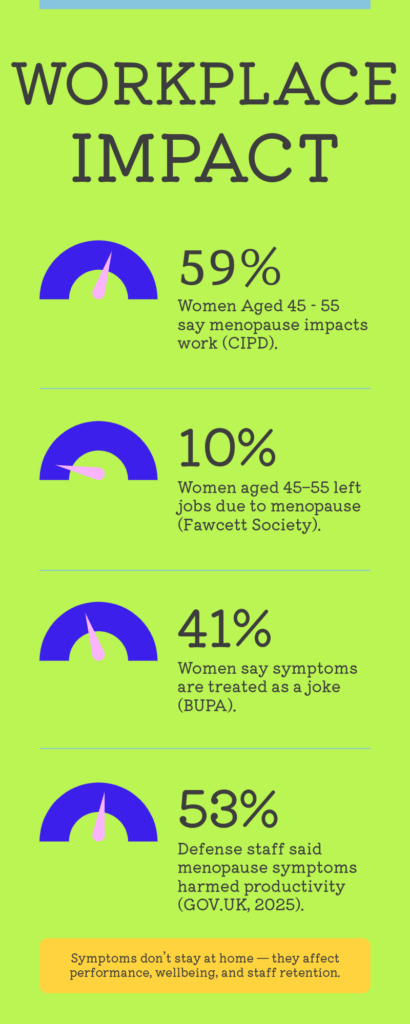
Menopause is often misunderstood or reduced to just a few well-known symptoms, but employers are up against a much broader reality. It can affect issues such as physical health, mood, cognition, and energy levels, and these changes don’t stop at home. That is, they can have a direct impact on confidence, productivity, as well as career choices. The following snapshots highlight the wide range of symptoms, together with the workplace impact, that employers need to understand.
Conclusion: The Bottom Line
To sum up, menopause is not a niche wellbeing topic. It is a workforce issue balanced against risk and productivity that now sits squarely within UK equality, health and safety, and employment frameworks. However, busting the myths is the first step; the next would therefore be translating clarity into day-to-day practice. That means, for example, proportionate adjustments as well as confident managers, and a policy that employees can actually use. If your organisation is at, for instance, “myths understood” but not yet “practice embedded”, move to implementation now before small issues become, for example, grievances, sickness absence, or reputational harm.
Want to know more about who we are and how we work?
Visit our About Us page. At Stevenson Brown, we help organisations create clear, practical Menopause Policies that protect staff and support compliance. For a concise expert explainer, see the National Institute on Aging video, What Is Menopause?
Next Steps
You Can Do Now
- Map your exposure: list where Equality Act, EHRC guidance, and Health & Safety duties meet real work (rotas, PPE, temperature, breaks), and note any live risks or complaints.
- Download our Menopause Policy Toolkit to help you write a practical and compliant menopause policy that your managers can implement (PDF, 7 PAGES, 639 KB).
How We Help
- Book a Menopause Policy Check In: a 30-minute consultation to review your risks, gaps, and next practical steps. Fixed fee; can be offset against a full policy commission if you proceed.
- Book a Policy Health Check: We can assist you to collate what exists: pull your current policies (absence, flexible working, EDI, risk assessment) and highlight overlaps, outdated text, contradictions, gaps and missing clauses.
- Draft a menopause policy that is tailored to your organisation and is aligned to UK law and EHRC guidance (fixed-fee, fast turnaround).
- Purchase our compliant and inspection-ready Menopause Policy Template to complete your policy with confidence.
How can we help?
Get in Touch
Find out how Stevenson Brown can assist your business
Copyright ©2021 • Stevenson Brown Limited