
Menopause at Work Series (3)  7 Min Read 2025
Part 3 - Menopause at Work: Busting Myths
Stevenson Brown
You are reading Part 3 of our Menopause at Work series. This article, “Busting Myths,” tackles common misconceptions about menopause at work head-on. Part 4, “Building Better Policies,” helps employers turn guidance into action. Part 1, “From Silent Struggle to Legal Recognition,” explains why menopause has become a workplace and legal issue, highlighting its personal impact on employees and the growing duty on employers to respond, and Part 2, “About Menopause,” explores symptoms, challenges, and broader impacts and explains menopause and perimenopause in more depth.
Understanding the Power of Myths
Menopause is one of the most common life stages for women, yet it remains one of the most misunderstood. Too often, it is clouded by stereotypes and assumptions rather than facts. These myths shape how colleagues respond, how managers make decisions, and whether employees feel able to ask for support.
When left unchallenged, myths create stigma and silence. Women may downplay their symptoms, employers may underestimate their responsibilities, and organisations risk higher turnover, absenteeism, and loss of valuable skills. Recognising menopause as part of workplace wellbeing is not just about fairness — it is about sustaining performance and building inclusive workplaces.
important things you should know
Common Myth vs Reality
In this section, we tackle some of the most persistent myths about menopause and perimenopause. Each one is explored in detail in the tabs below, showing what is often assumed, and the reality backed by evidence and lived experience. The nine myths we address are listed below.
Myth 1: Menopause Only Affects Older Employees.
Reality: Many begin experiencing symptoms in perimenopause well before “official” menopause. Also, early menopause, medical treatments (like chemotherapy), or surgical procedures (like hysterectomy) can trigger menopause at much younger ages. This means colleagues in their 20s or 30s may also need workplace support.
Myth 2: Menopause Is Only About Hot Flushes.
Reality: Symptoms range far wider than just hot flushes; fatigue, memory issues, sleep disturbance, mood changes…all of which have been shown to affect work performance. (British Menopause Society, 2025)
Myth 3: Symptoms Are Short-Term And Mild.
Fact: Reality: Menopause is not a brief or minor phase. For many, symptoms can last 7–10 years or longer, and they can be severe, ranging from insomnia and brain fog to anxiety and depression. In some cases, symptoms may be long-term and fall under the Equality Act 2010, requiring employers to make reasonable adjustments to accommodate them. The idea that menopause is a short blip minimises the sustained impact it can have on work and wellbeing.
Myth 4: Menopause Is A Private Matter, Not A Workplace Issue And Talking About It At Work Is Unprofessional.
Reality: Like pregnancy, mental health, or disability, menopause can affect attendance, performance, and equality. Employers have a duty to support staff impartially. Treating menopause as “off-limits” fuels stigma. When handled with respect and professionalism, like any other workplace health issue, it creates a safer and more inclusive culture.
Silence breeds stigma. When handled professionally, conversations about menopause are no different from discussions about any other health or wellbeing matter.
Myth 5: All Women Experience Menopause The Same Way.
Fact: Reality: Every woman’s experience is different. Some may have few symptoms, while others face significant physical, cognitive, and emotional challenges. Age, ethnicity, lifestyle, and health conditions can all influence severity. A one-size-fits-all approach will not work. Workplace policies must be flexible enough to recognise and support this diversity.
Myth 6: Menopause Support Means Lowering Standards.
Supportive measures don’t lower standards; they sustain them. Simple adjustments such as flexible hours, uniform adaptations, or access to quiet rest spaces enable employees to perform at their best. Providing support ensures consistency, reduces absenteeism, and strengthens workplace culture.
Myth 7: Men Don’t Need To Understand Menopause
Reality: Menopause affects entire workplaces, not just women. Male colleagues and managers play a crucial role in shaping culture, breaking stigma, and building inclusive teams. Without awareness, misunderstandings persist and silence deepens. Managers need to understand it, colleagues need to support it, and workplaces need policies to handle it — regardless of gender.
Myth 8: Employers Have No Legal Responsibility.
Reality: Employers already have duties under health and safety law and the Equality Act 2010. The Employment Rights Bill goes further, requiring organisations with 250 or more staff to publish a menopause action plan. Ignoring menopause is no longer just poor practice; it exposes employers to legal, reputational, and operational risks.
Myth 9: Providing Menopause Support Costs Too Much And Doesn’t Make A Difference.
Reality: Most adjustments are low-cost or free — flexible hours, uniforms made of lighter fabrics, or awareness training. The real expense comes from staff turnover, absenteeism, and tribunal claims when support is ignored.
Evidence shows that clear menopause workplace policies improve retention, reduce absence, and strengthen workplace culture. Action plans are not “tick-box” exercises — they set expectations, provide consistency, and demonstrate accountability. Done well, they transform how employees are supported and protect organisations from compliance gaps.
The Cost of Letting Myths Stand
When myths go unchallenged, the price is high. Stigma and silence don’t just harm individuals — they damage entire organisations.
- Women leave the workforce early, taking valuable skills and experience with them.
- Absenteeism rises as unmanaged symptoms make it harder to cope at work.
- Presenteeism increases, with staff physically present but unable to perform at their best.
- Colleagues shoulder additional pressure, leading to resentment and burnout.
- Recruitment and training costs escalate as experienced staff are lost.
- Careers stall, promotions are missed, and gender inequality deepens.
- Reputational damage grows when organisations are seen as unsupportive or out of touch.
In short, myths erode confidence, weaken teams, and undermine performance. The cost of silence is far greater than the cost of support.
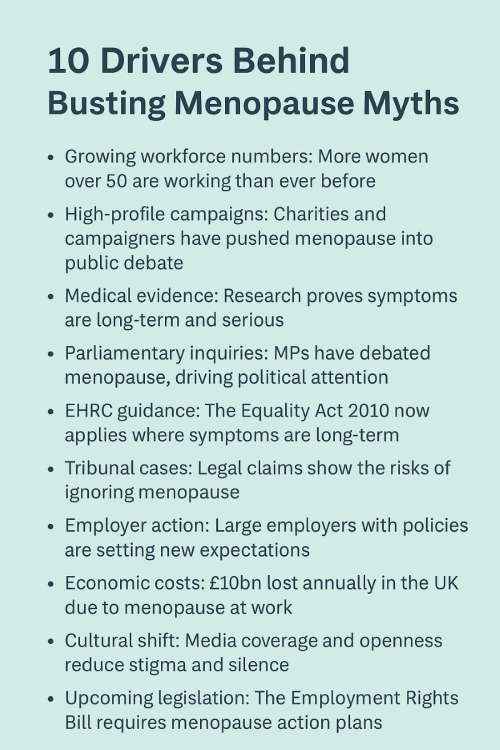
10 Drivers Behind Busting the Myths
A combination of cultural, medical, and policy shifts has brought menopause out of the shadows and into the workplace conversation. See below, 10 ways myths are being dismantled.
Conclusion: Moving Beyond the Myths
Challenging myths is the foundation for meaningful change. When employers replace misconceptions with evidence and empathy, they create workplaces that are inclusive, resilient, and legally compliant.
Want to know more about who we are and how we work?
Visit our About Us page. At Stevenson Brown, we help organisations create clear, practical Menopause Policies that protect staff and support compliance. To complement this, watch the National Institute on Aging’s video “What Are the Signs and Symptoms of Menopause?” for a clearer overview of the changes many women experience and why awareness matters in every workplace.
Next Steps
You Can Do Now
- Make a simple “myths list”: write your top five menopause myths, add a one-sentence fact for each, and note which policy section they belong in (e.g., Definitions, Reasonable Adjustments, Sickness Absence, Performance). Include any real examples or complaints that show risk.
- Download our Menopause Policy Toolkit to help you write a practical and compliant menopause policy that your managers can implement (PDF, 7 PAGES, 639 KB).
How We Help
- Book a Menopause Policy Check In: a 30-minute consultation to review your risks, gaps, and next practical steps. Fixed fee; can be offset against a full policy commission if you proceed.
- Book a Policy Health Check: We can assist you to collate what exists: pull your current policies (absence, flexible working, EDI, risk assessment) and highlight overlaps, outdated text, contradictions, gaps and missing clauses.
- Draft a menopause policy that is tailored to your organisation and is aligned to UK law and EHRC guidance (fixed-fee, fast turnaround).
- Purchase our compliant and inspection-ready Menopause Policy Template to complete your policy with confidence.
How can we help?
Get in Touch
Find out how Stevenson Brown can assist your business
Copyright ©2021 • Stevenson Brown Limited